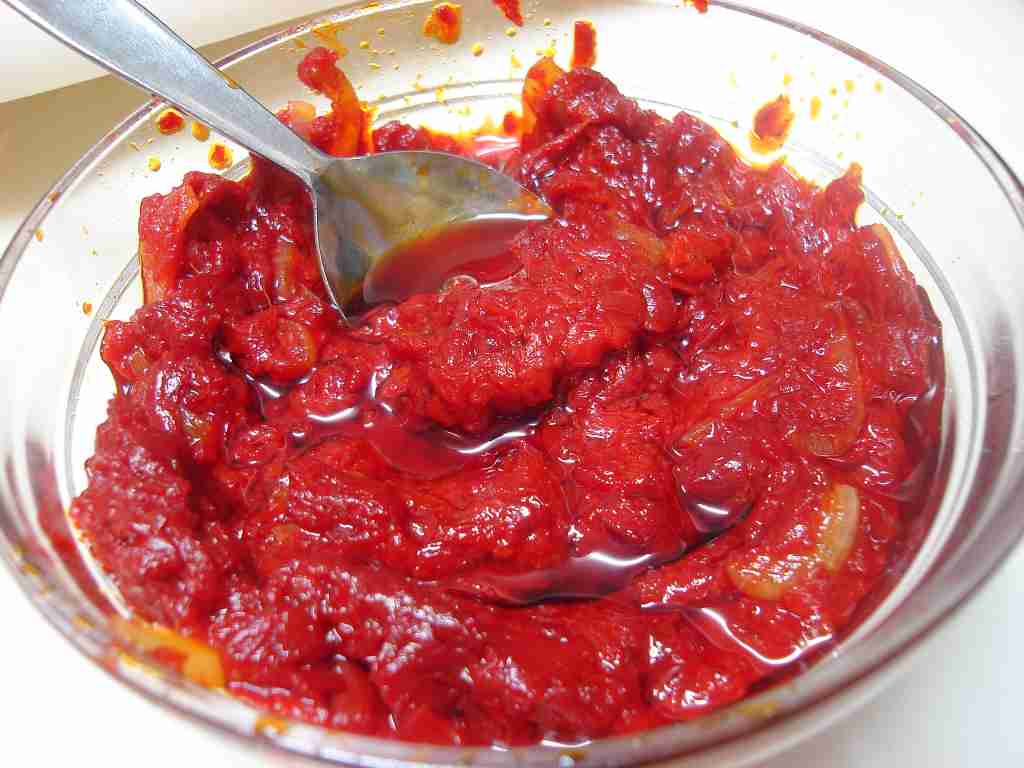
The stir fried red durian of Sandakan is a very rare because red durian is very difficult to find. It was mistakenly called Tempoyak by people in Sandakan, i.e. myself and my family until I found out what normal tempoyak really is.
In Sandakan, this durian(called Alau in Kinabatangan) is not planted but found in the forests of the Kinabatangan river basin. It is extremely difficult and tedius to harvest because it does not fall down by itself. It must be collected from the tree. Extracting the flesh from its seeds is also very tedious.
There is no need to ferment it like the normal tempoyak. It is just salted in order to preserve it, and stir fried with onion and chili padi with a little bit of oil.
This wild red durian is not sweet but creamily rich so it is not competitive as a fruit against the yellowish durian, but as a cooked food, it is the best. I have tested the normal tempoyak made from fermented yellowish durian from Malaya but I cannot take them. Even the sweet orangish and reddish durian of the West Coast of Sabah(Durian Dalit ), is unpalatable to me as a main course food, but my sister, as well as many Sabahans, can take it with relish. Some will even eat any durian, raw, with their rice.
Eating this tempoyak of Sabah, is an acquired taste. My children and most of my brothers do not like it. To me, this food is among the most delicious in the whole world because it is aromatically creamy, without the strong smell of normal durian, and without excessive sourness of fermented tempoyak.
Below is the orange Alau which is less delicious to me than the red Alau.
In Keningau, this orangish durian is found in the wild and is called Sukang but they eat it raw just like any fruit. According to the enthusiast, they like eating it because it does not make the eater sick no matter how much he eats it. It therefore never manages to reach the food table as a cooked food.
These types of durian can be found all over Sabah, from Tawau to Kuala Penyu but not many places eat that as cooked food. Probably these durian are eaten cooked only in Kinabatangan and some parts of Sarawak, by year 2007.
Another type, which is even more aromatic, is the dark brown durian.

 Siagul at the left is the one that our family cooks. It's recipe is different from those described in the google search. It is very different from our Filipino neighbours.